Four Immeasurables as Visual Feelings
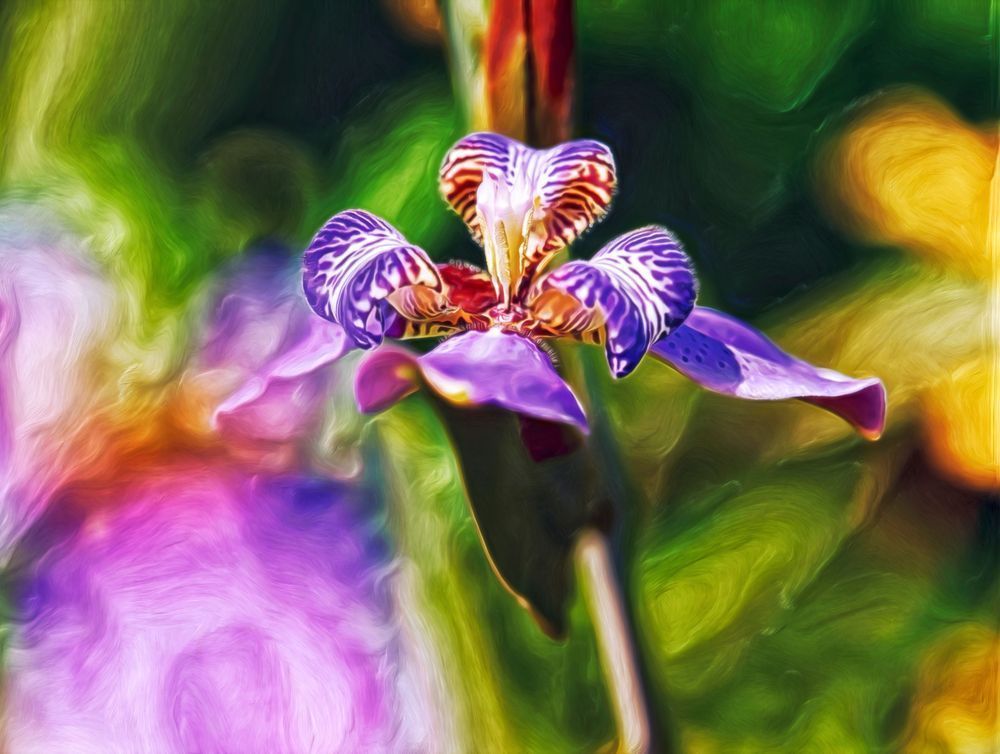
"Iris Versicolor" emerges as a transmission vessel for empathetic joy and loving-kindness, the two dominant immeasurables embodied through visual elements that speak directly to the heart. The painting channels empathetic joy through its radiant purple petals, marked with intricate striations of deep violet and warm amber-orange, celebrating the iris's natural triumph as it blooms into focused clarity against softened companions. This rejoicing in beauty's success manifests through the artist's deliberate choice to honor one blossom in sharp detail while others dissolve into soft-focus halos of lavender and rose, demonstrating that true joy includes witnessing others' glory without attachment. The loving-kindness dimension radiates through the painting's warm color palette of purples blending into peachy-pink backgrounds, creating what color theory research identifies as emotional contagion—where hues trigger the release of dopamine and foster feelings of uplift and connection. The bokeh effect achieved through the deliberately blurred foreground and background irises functions as visual equanimity, teaching the Buddhist principle of non-attachment by showing how beauty exists in both clarity and dissolution. Research on contemplative art confirms that these visual strategies function as art-therapy mechanisms, allowing viewers to process emotions through color, form, and the interplay of focus and release. As scholars note, Buddhist art serves as a support for practice, and this painting fulfills that function by encoding the Four Immeasurables into accessible visual language that bypasses intellectual understanding to create direct somatic resonance.
Large Canvas Experience
When displayed at 53×40 inches, "Iris Versicolor" transforms from image into immersive environment, creating what neuroscience research identifies as perceptual scale expansion, in which large artworks command sustained attention and trigger awe responses in the viewer's brain. At this substantial scale, the purple iris becomes a life-sized botanical presence, its intricate veining and luminous color gradations revealing details imperceptible in smaller formats, while the soft-focus companion blooms create a sense of atmospheric depth that pulls viewers into a contemplative three-dimensional space. The bokeh backgrounds at monumental scale evoke what art psychologists describe as emotional landscapes—the peachy-pink and golden-green halos become color fields reminiscent of meditative canvases, where expansive hues envelope the viewer in tranquil immersion. Research confirms that large-scale color experiences trigger extended contemplation, as the eye travels across the canvas, discovering new relationships between the focused iris and its blurred companions, creating a visual rhythm between clarity and mystery. The purple's association with wisdom and spiritual awareness becomes amplified at this scale, as viewers reported feeling physically surrounded by the painting's calming energy. The soft edges and atmospheric transitions between focused and unfocused elements create what photography experts call depth-perception cues, in which the brain interprets blur as spatial distance, making the 53×40 canvas feel like a window into an actual garden rather than a flat surface. Art collectors note that large-format works create daily rhythm companions—pieces that viewers return to repeatedly, discovering new emotional responses as light conditions change throughout the day. The beginner's mind quality of the composition—its simple focus on a single iris without pretension—allows viewers to approach the work with openness and receptivity, the Zen principle of shoshin that encourages experiencing beauty as if seeing it for the first time.