4 Immeasurables as Visual Feelings
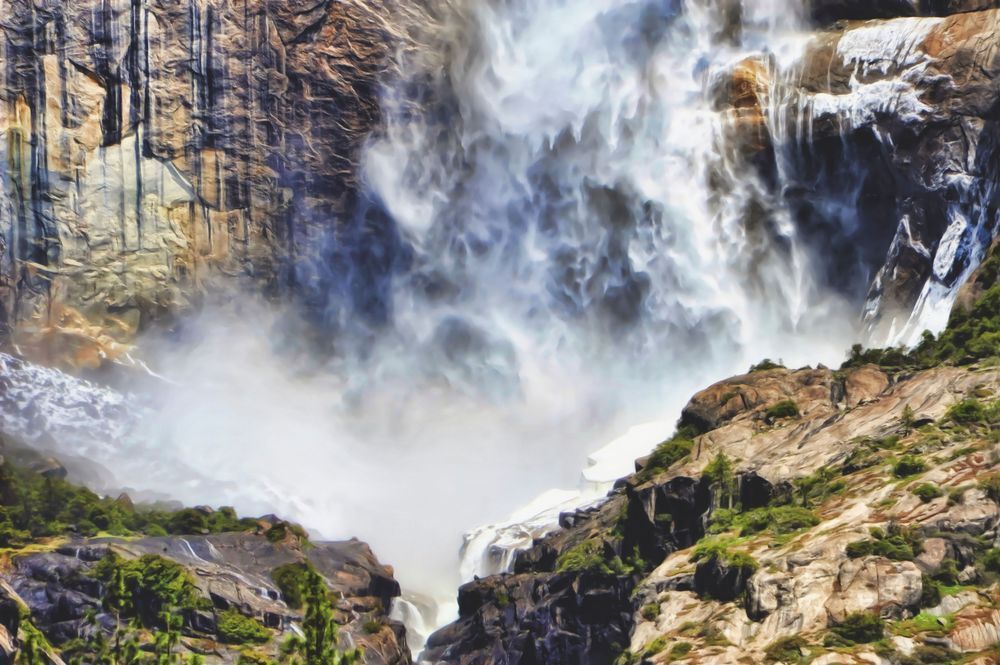
"Yosemite Falls Roaring" embodies primarily Empathetic Joy and Loving-Kindness as its dominant transmissions. The cascading torrents, painted in luminous whites and cool blues against warm golden-ochre cliffs, create a visual symphony that celebrates the inherent delight in nature's power. Research demonstrates that viewing waterfall imagery physiologically activates positive mood states while providing comfortable, relaxed, and natural impressions. Physician-artist Dr. Mehta's deliberate use of warm color advancement in the foreground rocks and cool color recession in the upper atmosphere follows established color temperature principles that guide the viewer's eye through a journey of discovery. The painting functions as a transmission vehicle through its dynamic movement and cascading energy, where water represents the continuous flow of abundance and vitality according to ancient wisdom traditions. The emotional resonance captured here—roaring falls framed by verdant mist and ancient stone—invites viewers to experience empathetic joy in nature's unstoppable vitality while simultaneously offering loving-kindness through its invitation to pause and witness beauty. As a tool for art healing, this work provides what contemporary research identifies as eustress—positive physiological awakening combined with psychological relaxation—making it particularly effective for therapeutic visual experience.
Large Canvas Experience
Displayed at 60×40 inches, this painting transforms from image into environmental presence, creating what gallery professionals describe as a command piece that anchors entire rooms. At this substantial scale, the waterfall becomes nearly life-sized, triggering viewers' visceral responses to cascading water's power—the roaring sound seems almost audible, the cool mist almost tangible against skin. Research on large-format art confirms that scale fundamentally alters color perception: the golden warmth of sunlit cliffs intensifies and advances toward viewers, while blue-violet shadows create atmospheric depth that pulls the eye upward along the vertical cascade. Extended contemplation before this immersive canvas activates what neuroscience identifies as the brain's reward network, releasing dopamine while simultaneously reducing cortisol—the stress hormone. The painting's physical presence commands approximately 60-75% of optimal wall space, establishing visual authority without overwhelming. Associations emerge organically: the rhythmic cascade suggests musical crescendos, the textured brushwork invites tactile imagination, and the compositional movement from base to apex mirrors the viewer's own upward gaze, creating kinesthetic engagement. Museums utilizing large-scale immersive art report that visitors experience "emotional impact that pulls people in", precisely what this monumental format achieves—transforming passive viewing into an active multisensory encounter where boundaries between observer and observed dissolve.