Four Immeasurables as Visual Feelings
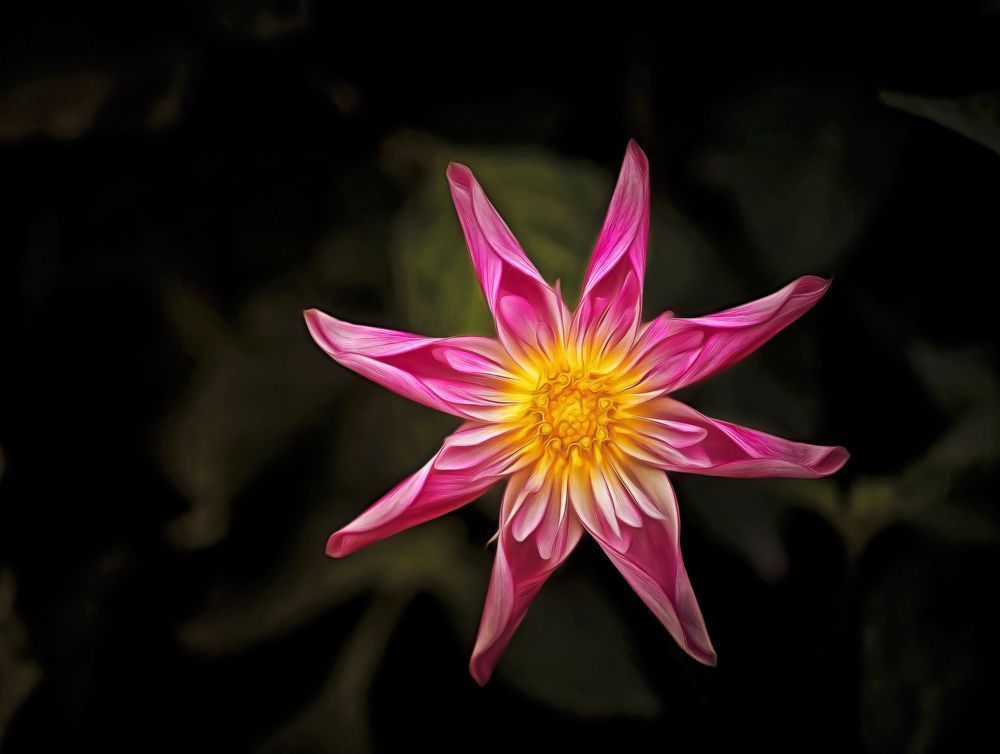
This radiant "Star Flower" painting primarily aligns with Empathetic Joy and Loving-Kindness, the first two of the Four Immeasurables central to the physician-artist's two-decade practice. The star-shaped dahlia-like flower—rendered in luminous pink petals transitioning to a golden-yellow center—embodies Empathetic Joy through its celebratory chromatic energy and its explosive radial composition, which rejoices in the beauty of existence without attachment. The pink coloration specifically references the lotus flower tradition in contemplative art, where pink represents the enlightened state itself and serves as an earthly symbol of spiritual awakening. Loving-Kindness manifests through the unconditional warmth of the golden center, which radiates outward like boundless friendliness extending in all directions, creating what scholars describe as a visual transmission of compassionate presence. The soft-focus background—muted olive-green tones dissolving into atmospheric darkness—provides the balanced acceptance of Equanimity, the grounding principle beneath all other immeasurables. This painting functions as a transmission vehicle for authentic connection by offering what research identifies as embodied perception—viewers experience the flower's physical presence as an invitation to emotional resonance and art therapy, where the physician-artist's heart channels decades of healing practice into visual form that addresses human suffering through beauty.
Large Canvas Experience
Encountering the "Star Flower" paintings at their monumental 53×40-inch dimensions transforms color perception into an immersive field that commands the viewer's complete visual attention, creating what researchers describe as an encompassing aesthetic experience in which the artwork becomes an environment rather than an object. At this substantial scale, the pink petals transition from representational elements into color fields that fill peripheral vision, triggering what studies identify as multisensory associations—the warm pink evokes tactile softness akin to silk or flower petals, while the radiating golden center suggests auditory warmth like sustained musical tones or gentle chimes. The large format creates what gallery professionals term physical presence, where the painting's scale generates spatial transformation—smaller rooms gain visual expansion through the flower's outward energy. In contrast, larger spaces achieve intimate focus as the composition draws viewers into meditative contemplation. Extended viewing at this scale produces temporal shifts in emotional response; initial encounters register as visual joy and surprise, while sustained engagement (three to five minutes) transitions viewers into contemplative states where the color interactions—the pink-to-yellow gradient, the olive-green atmospheric depth—create what color field painting scholars describe as spiritual depth and meditative absorption. The monumental canvas encourages embodied engagement where viewers physically step closer to examine brushwork texture, then retreat to absorb the unified composition, creating a movement-based dialogue with the artwork that research confirms enhances aesthetic pleasure and emotional processing. Collectors report that living with large-scale contemplative paintings enhances daily mood and reduces stress, as the artwork becomes a constant companion, offering visual refuge from chaotic modern life.