Four Immeasurables as Visual Feelings
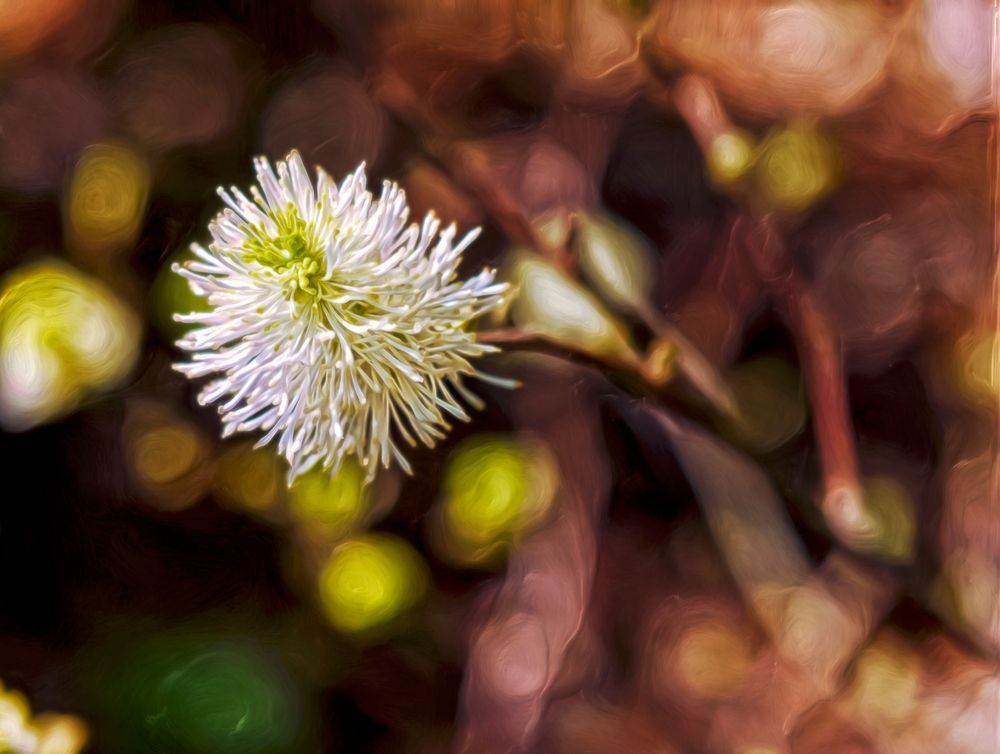
"Resplendent" radiates the boundless qualities of empathetic joy and loving-kindness, offering viewers an encounter with authentic happiness that transcends ordinary visual experience. The painting captures a delicate white flower—likely a species with fine, spiky petals characteristic of native flora—surrounded by luminous bokeh orbs in warm yellows and cool greens, creating an atmosphere of celebration and unconditional friendliness. The radiant center of the blossom, rendered in vivid chartreuse, serves as the visual transmission vehicle for joy, drawing the eye inward before releasing it outward into the surrounding aureoles of color that seem to breathe with life. Dr. Mehta's contemplative approach to this subject matter—focusing intently on a single flower until its beauty becomes overwhelming—mirrors the Buddhist practice of sustained attention that reveals the extraordinary within the ordinary. The ethereal quality of the background, with its soft-focus circles of light reminiscent of natural illumination filtering through leaves, creates a sense of interconnectedness between subject and environment that embodies equanimity and non-attachment. Through deliberate compositional choices—the flower positioned slightly off-center, the dynamic interplay between sharp focus and gentle dissolution—the painting demonstrates how visual elements can transmit the immeasurable qualities central to Buddhist practice, functioning as what contemporary gallerists recognize as affective art that promotes psychological well-being and emotional healing.
Large Canvas Experience
Displayed at substantial scale (53×40 inches), "Resplendent" transforms from photograph into an immersive environment, commanding physical presence that envelops viewers in a chromatic field of luminous vitality. The large format amplifies the painting's emotional intensity, as research confirms that scale dramatically influences how observers perceive color saturation and compositional impact—larger works evoking feelings of awe and transcendence that smaller reproductions cannot achieve. At this monumental size, the bokeh orbs become tangible spheres of pulsating energy, their warm golden tones evoking the warmth of sunlight while cool green hues suggest forest canopy and natural serenity, engaging what neuroscientists call embodied perception, where viewers physically respond to visual stimuli. Extended contemplation of the work reveals subtle gradations within each color zone—the way yellow transitions to amber, how green deepens to emerald in shadow—creating what art historians term optical mixing, generating additional hues not physically present on the canvas. The sharp delineation of the flower's white petals against the atmospheric background produces a spatial tension that draws viewers into alternating states of focused attention and meditative drift, mimicking the contemplative rhythm of mindfulness practice. Museum studies demonstrate that large-scale paintings engage the peripheral vision, creating an encompassing experience where the artwork feels less like an object observed and more like an environment inhabited, a chromatic atmosphere that viewers enter rather than merely view. The vertical orientation and substantial height position the flower at eye level for most viewers, establishing an intimate relationship as if encountering the bloom in its natural habitat, while the generous width allows the bokeh pattern to extend beyond normal visual field, creating what immersive art specialists call a wraparound effect that promotes emotional transportation.