Four Immeasurables as Visual Feelings
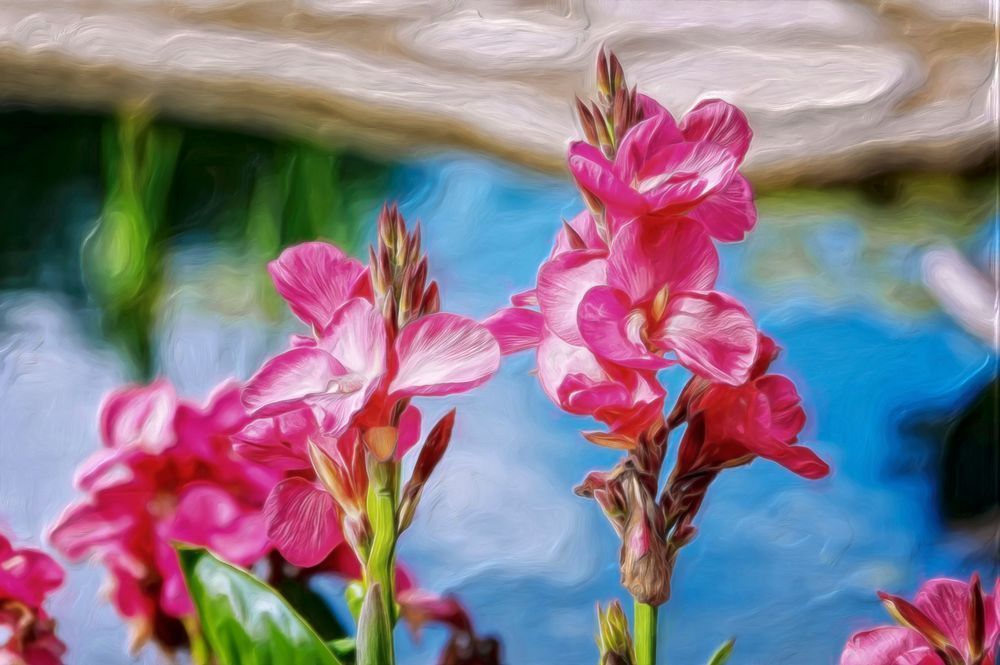
"Pink Flags Waving" expresses empathetic joy and loving-kindness as its primary emotional dimensions, embodying the physician-artist's decades-long practice of healing through these boundless principles. The vibrant pink blooms—likely gladiolus or canna lilies rendered with expressive brushwork—rise triumphantly against a softened architectural background, their upward movement and warm hue psychology creating an immediate transmission of compassionate celebration. Pink as a color represents unconditional love, tenderness, and nurturing, qualities that align precisely with loving-kindness, while the flowers' triumphant positioning and the painting's title "Pink Flags Waving" suggest the rejoicing nature of empathetic joy—celebrating beauty and vitality without envy or reservation. The painterly technique creates what scholars describe as "visual transmission" in Buddhist art, in which the artist's contemplative state is conveyed directly through gestural marks and color relationships. The blurred background with its turquoise and cream tones offers what Zen aesthetics calls wabi-sabi—the beauty of impermanence and imperfection, while the sharp foreground flowers embody presence and mindful attention. This composition functions as art therapy by inviting viewers into a beginner's mind state—the Zen concept of shoshin, where one approaches each moment with openness and fresh curiosity, free from preconception and judgment.
Large Canvas Experience
Displayed at 60×40 inches, this work transforms from an image into an immersive environment, commanding physical presence that contemporary galleries recognize as creating profound viewer engagement. At this monumental scale, the pink flowers achieve what art perception research identifies as "awe-inducing magnitude"—viewers must step back to absorb the entirety, then move closer to discover textural richness in each impasto stroke. The saturated pink hues intensify at large format, activating what color therapy researchers call chromotherapy effects—the calming yet uplifting properties of pink that reduce aggression while inspiring warmth and hope. The scale-to-viewing-distance relationship documented in museum studies suggests viewers naturally position themselves 1.5 to 2.5 meters from this canvas, creating an enveloping experience in which peripheral vision captures the entire color field while central focus explores individual blooms and gestural marks. Extended contemplation reveals what immersive art scholars describe as temporal transformation—time slows, mental chatter quiets, and the painting becomes a meditative focal point. The architectural elements in soft focus suggest memory and place without specificity, allowing each viewer's personal associations to merge with the universal themes. The contrast between sharp florals and atmospheric background creates what photographers call the bokeh effect—the aesthetic quality of selective focus that isolates the subject while maintaining spatial context, producing depth perception and emotional atmosphere. This scale-dependent magic explains why contemporary gallerists position large-format works as focal anchors that transform entire rooms into experiential spaces, where art transcends decoration to become an environmental presence and emotional catalyst.