Four Immeasurables as Visual Feelings
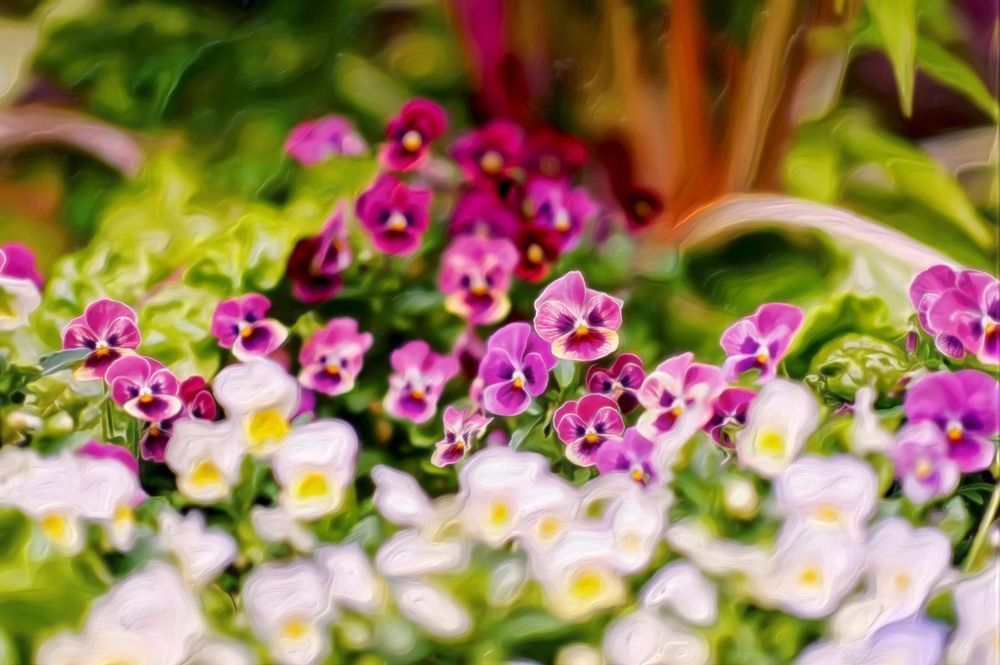
"Faces in a Crowd" embodies empathetic joy and loving-kindness as its primary immeasurable qualities, transmitting these principles through an exuberant celebration of botanical life that mirrors the interconnectedness central to contemplative practice. The vibrant purple and magenta pansies—historically symbolizing thoughtfulness, remembrance, and the act of holding others in mind—cluster alongside pure white blooms representing innocence and unblemished presence, creating what scholars identify as a visual transmission of joy and healing. Research confirms that large-scale floral compositions function as vehicles for emotional healing by evoking feelings of happiness, comfort, and genuine connection, while a balanced composition of warm and cool tones embodies the equanimity that underlies all four immeasurables. The painting operates as art therapy, where the vibrant color palette and layered textural elements create what contemporary Buddhist art scholars describe as a non-dual experience—the viewer does not merely observe joy but participates in its actualization. The pansy's face-like blooms, with their contemplative appearance, serve as portals for compassionate awareness, inviting extended engagement, while the white flowers provide visual breathing space that allows the mind to rest in beginner's mind awareness. Studies demonstrate that viewing floral artwork triggers the release of serotonin and reduces cortisol levels, creating measurable healing responses that align with the physician-artist's intention to transmit wellness through visual joy.
Large Canvas Experience
Displayed at 60×40 inches, this painting commands an immersive presence that fundamentally transforms the viewing encounter from observation to embodiment, with research indicating that canvases of this scale create optimal viewing distances of approximately 5 to 7 feet, placing viewers within the artwork's energetic field rather than outside it. The expanded scale amplifies the emotional resonance of the purple, magenta, pink, and white color harmonies, which studies show evoke distinct psychological responses—purple representing admiration and spiritual awareness, pink conveying gentle affection and compassion, and white offering purity and serenity. At this large format, the tactile brushwork and layered paint application become physically palpable, creating what art perception research identifies as a haptic visual experience where viewers perceive texture through sight alone, fostering a deeper mind-body connection. The painting's atmospheric depth—achieved through the interplay of sharp foreground pansies against softly diffused background elements—generates what scholars term absorption, where the viewer's attention concentrates intensely on the pictorial surface, facilitating meditative states. Extended contemplation at this scale reveals subtle chromatic vibrations between adjacent warm and cool passages, creating visual experiences akin to listening to harmonious resonance—colors appear to hum against one another, forms seem to breathe with organic rhythm, and the overall composition evokes the gentle movement of a garden responding to the breeze. The commanding physical presence of the work at substantial dimensions offers what museum research confirms as an experiential phenomenon rather than mere viewing, transforming gallery or home spaces into sanctuaries of visual healing energy.