Four Immeasurables as Visual Feelings
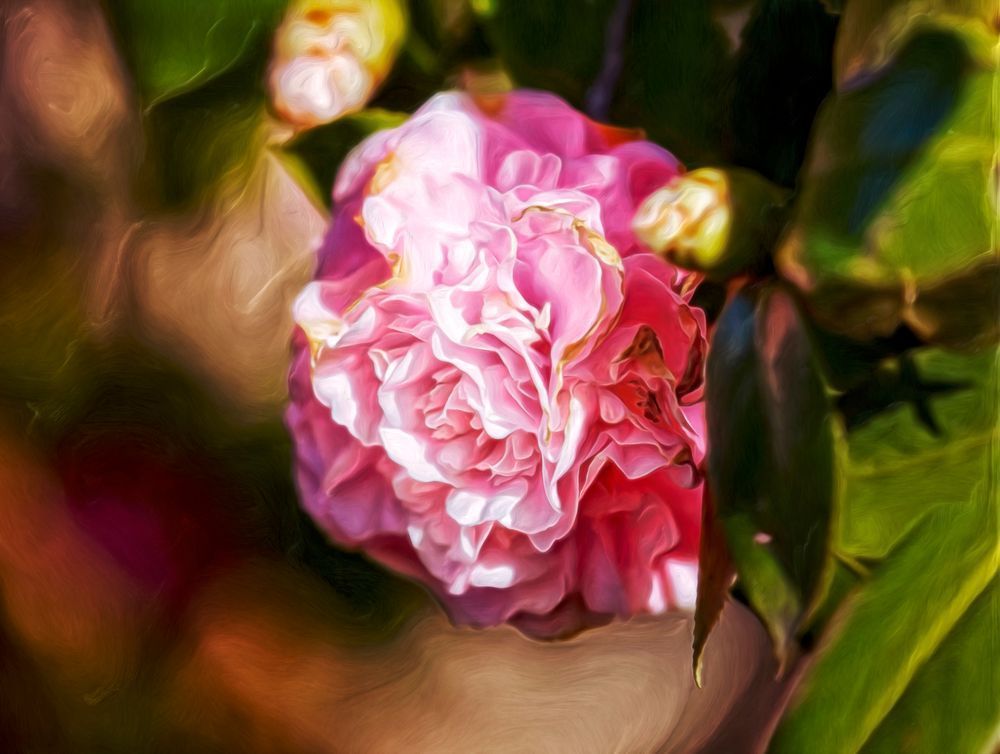
"Dark Peony" serves as a visual transmission vehicle for the Four Immeasurables central to healing practice, with empathetic joy and equanimity emerging as the two primary boundless states embodied within this work. The painting achieves this through Dr. Mehta's distinctive approach of rendering luminous pink and coral-toned blooms set against deep, shadowed foliage, creating what scholars describe as emotional contrast—the tension between light and darkness that mirrors life's dualities. The soft, almost luminous petals, painted with delicate gradations, suggest empathetic joy, inviting viewers to celebrate beauty's transient presence even amid uncertainty, much as peonies symbolize happiness, prosperity, and healing across cultures while acknowledging their brief blooming season. Research confirms that floral imagery, particularly when rendered at a substantial scale with atmospheric depth, functions as art therapy by reducing stress hormones and creating what museum studies call an emotional refuge. The darker background elements establish equanimity—the balanced acceptance that embraces both shadow and illumination without preference. This painting becomes a transmission of joy through what contemplative traditions call beginner's mind, the fresh, non-judgmental perception that sees each bloom as simultaneously fragile and resilient, teaching viewers to hold opposing truths with grace. Dr. Mehta's physician-artist perspective, shaped by decades of practicing the Four Immeasurables in clinical settings, infuses the work with compassionate presence—the painting doesn't demand interpretation but offers itself as therapeutic companionship, a visual healing practice that allows feelings to surface and transform.
Large Canvas Experience
Envisioned as a substantial 53×40-inch canvas, "Dark Peony" transforms from an image into emotional architecture, commanding physical and psychological space in ways that fundamentally alter viewer engagement. Research on large-scale painting demonstrates that substantial formats create immersive environments in which viewers are enveloped rather than merely observers—the work shifts from decoration to an experiential encounter. At this monumental scale, the color perception transforms dramatically: the deep greens and shadowed backgrounds no longer recede but surround viewers in what museum studies term atmospheric presence, while the luminous pinks and coral tones of the peony seem to radiate outward, creating what researchers describe as visual breathing—colors that pulse with organic vitality. The painting commands what gallerists call emotional gravity, drawing viewers into extended contemplation in which the boundaries between observer and observed begin to dissolve —a phenomenon documented in studies of large-format emotional abstraction. Extended viewing at this scale initiates a meditative encounter: viewers report shifting through stages from initial visual impact to deeper emotional recognition, finally arriving at what contemplative traditions describe as direct experience—the painting becomes less an object to analyze and more a presence to inhabit. The substantial dimensions create what color theorists identify as chromatic immersion, in which warm floral tones and cool shadowed areas establish temperature contrasts that viewers experience as tactile sensations—warmth seeming to emanate from illuminated petals. In contrast, cooler shadows suggest depth and mystery. This scale allows for visual orchestration across viewing distances: from across a room, the composition reads as bold gestural harmony; at middle distance, the interplay between light-filled blooms and mysterious darkness reveals itself; while close examination uncovers brushwork nuances and painterly decisions that invite appreciation of creative process. The work's physical presence generates what collectors describe as room transformation—not merely filling wall space but redefining the emotional tone of the entire environment, establishing what art therapy research identifies as a healing focal point that offers daily opportunities for contemplative pause and emotional recalibration.