Four Immeasurables as Visual Feelings
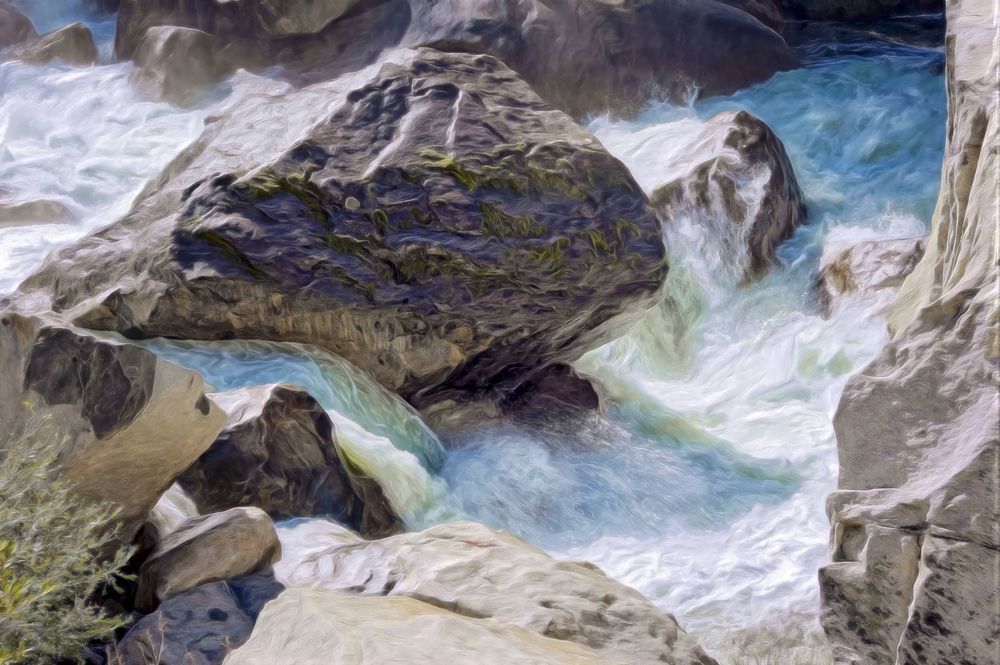
"Crashing Rock" functions primarily as a visual transmission of empathetic joy and equanimity, two boundless principles that dance together throughout this dynamic composition. The kinetic energy of turbulent waters colliding with steadfast rocks embodies empathetic joy—that luminous quality of celebrating vitality and existence without attachment—while the compositional balance between chaos and permanence manifests equanimity, the unwavering acceptance that holds space for all experience. The painting's textural vitality transforms aggressive natural forces into celebratory brushwork, where white foam becomes visual exuberance and moss-covered stone surfaces anchor fleeting motion in timeless presence. Through warm ochre tones juxtaposed against cool turquoise depths, the work creates what healing traditions describe as the "boundless state," where viewers witness turbulence without drowning in it, finding emotional refuge in the artist's capacity to hold both dynamic movement and grounded stillness simultaneously. This painting operates as what contemporary art theory calls an emotional transmission vehicle—not merely depicting nature but channeling the physician-artist's two-decade practice of holding contradictory states with compassionate presence, inviting viewers into what scholars identify as art therapy's healing dimension, where observation itself becomes transformative.
Large Canvas Experience
Displayed at 60×40 inches, "Crashing Rock" commands what gallery professionals term monumental presence, fundamentally altering how color and form penetrate consciousness. At this impactful scale, the turquoise water passages no longer register as a painted surface but as spatial portals, drawing viewers into what neuroscience calls the blue-mind effect—that measurable shift toward meditative brain states when encountering water imagery at commanding dimensions. The painting's vigorous brushstrokes and layered texture gain sculptural physicality, transforming the two-dimensional canvas into a tactile landscape where viewers instinctively trace the rhythmic patterns of water flow, creating what researchers document as cross-modal perception—the brain translating visual texture into imagined sound of rushing water and sensation of ocean spray. Extended contemplation at this gallery scale triggers what aesthetic research identifies as awe response, that measurable physiological effect where heart rate slows and attention narrows to present-moment absorption, particularly powerful in nature-based compositions displaying elemental forces. The warm stone tones and cool aquatic hues intensify their emotional resonance when encountered at life scale, activating what color psychology terms temperature perception—viewers reporting they "feel" the warmth radiating from sun-touched rocks and coolness emanating from shadowed water channels. This immersive viewing experience at substantial scale generates what contemporary galleries recognize as atmospheric transformation—the painting doesn't merely hang in space but actively reshapes room energy, becoming what interior design specialists call an emotional anchor that shifts collective mood toward tranquility balanced with vitality.