4 Immeasurables as Visual Feelings
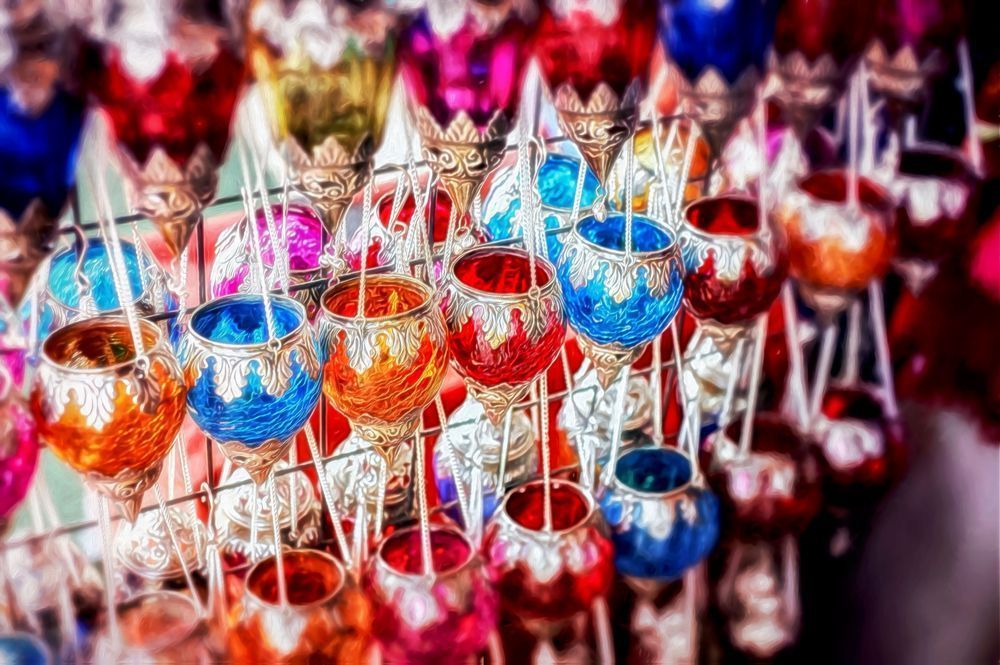
"Bright Indian Votives" primarily serves as a vehicle for empathetic joy and loving-kindness, radiating these qualities through its luminous orchestration of colored glass forms that glow with joyous intention. The painting's jewel-toned votives—shimmering in electric blues, radiant oranges, deep crimsons, and brilliant magentas—embody empathetic joy through their celebration of collective illumination, where each candle flame represents the shared happiness of community ritual and spiritual devotion. This color field of vivid light invites viewers to rejoice in the beauty of offerings made by countless hands, creating what neuroscience research identifies as emotional contagion, in which the artwork's joyful energy directly influences the viewer's emotional state. The loving-kindness principle manifests through the painting's tender attention to each votive holder, whose ornate metalwork speaks to the care and devotion embedded in religious craftsmanship, while the soft bokeh in the background suggests the infinite field of compassion extending beyond what we can see. The warm color palette—dominated by oranges symbolizing creativity, purity, and spiritual illumination in both Hindu and Buddhist traditions—activates neural pathways associated with joy and social connection, creating what researchers describe as the artwork's therapeutic presence. By depicting votives as vessels of light rather than objects, the physician-artist transforms functional items into embodied symbols of healing intention, mirroring Dr. Mehta's two-decade practice of the 4 Immeasurables in clinical care, in which each patient encounter becomes an opportunity for transmitting these boundless qualities. The painting achieves its art-therapy function not by representing suffering, but by offering viewers direct visual access to joy as medicine—a beginner's mind approach that strips away cynicism to reveal the pure delight found in sacred color and light.
Large Canvas Experience
When displayed as a substantial 60×40-inch canvas, "Bright Indian Votives" transforms from painting to an immersive color environment, enveloping viewers in what researchers call an aesthetic presence that alters spatial and emotional perception. At this commanding scale, the jeweled votives become nearly life-sized, creating the sensation of standing before an actual altar of flickering devotional lights, where the warm color vibrations—oranges, reds, and blues—trigger measurable physiological responses, including increased heart rate from warm tones and neural activation in brain regions associated with reward processing and emotional memory. The large format allows the metallic highlights on each votive holder to catch ambient light in the viewing space, creating a dynamic relationship between the artwork and its environment that changes throughout the day, much like real candles respond to shifting illumination. Viewers standing before this scale report what neuroscience identifies as embodied simulation, where the brain activates as if physically present in the depicted sacred space, with postural dynamics subtly shifting in response to the painting's visual rhythms and color patterns. The color saturation intensity at this scale creates what Mark Rothko described in his monumental works: not grandiosity but intimacy, as viewers find themselves drawn into prolonged contemplation, experiencing the synesthetic associations where vibrant oranges hum with warmth, cool blues offer pockets of serenity, and the overall composition pulses with the rhythm of collective prayer. The substantial canvas commands physical presence in a room, functioning less as decoration and more as an emotional anchor—a visual sanctuary that reduces cortisol levels and activates the parasympathetic nervous system, creating the physiological conditions for the calm alertness central to both medical practice and contemplative traditions. At 56×37 inches, the painting becomes what contemporary neuroscience research describes as an affective environment, where extended viewing allows the complex color relationships to reveal themselves gradually: the way magenta glows against turquoise, how golden metallics create visual bridges between color zones, and how the softened background allows the mind to rest while the foreground dazzles—creating the balance between stimulation and tranquility that characterizes optimal healing spaces.