Four Immeasurables as Visual Feelings
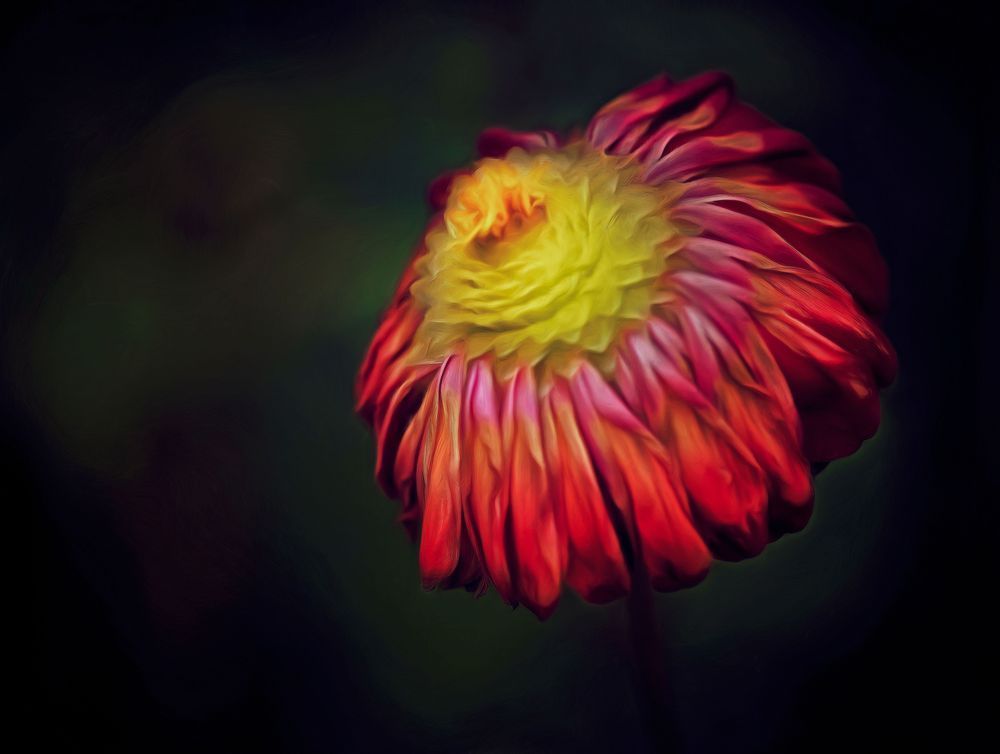
"Bolide" emerges as a radiant transmission vehicle for empathetic joy and loving-kindness, the two primary immeasurable qualities that define this healing art composition. The flower sermon tradition in contemplative practice recognizes that enlightenment can be transmitted through a single blossom's silent eloquence, and this painting honors that lineage through its luminous golden heart radiating outward into vibrant crimson petals against darkness. The warm colors—molten yellows bleeding into passionate reds and soft pinks—function as visual joy made tangible, embodying the unconditional friendliness of loving-kindness, wishing happiness for all beings without exception. Each petal unfurls with dynamic motion, creating emotional positioning that celebrates existence itself. In contrast, the compositional harmony between the bright center and the embracing outer petals demonstrates empathetic joy, the practice of rejoicing in beauty and vitality without possessiveness or envy. Contemporary gallery-viewing research confirms that original art displaying such color-field intensity triggers measurable neurological response patterns, including dopamine release and reduced cortisol levels, physiologically validating the painting's capacity as an art-healing instrument. The work functions as both mirror and medicine: the beginner mind approach to its creation—mindful creation without self-conscious expertise—allows the painting to become what contemplative masters describe as a "support for practice," a visual experience that cultivates boundless principles through sustained viewer engagement.
Large Canvas Experience
When "Bolide" commands 53×40 inches of wall space, the scale transformation transforms the viewing experience into an immersive experience that fundamentally alters perception and emotional response. At this large format, the golden center becomes a luminous portal that occupies peripheral vision even as viewers focus on individual petals, creating the sensory-rich environment that contemporary large-scale painting installations are engineered to produce. The warm colors at monumental size trigger what researchers identify as emotional contagion—the brain's tendency to mirror the vitality and energy radiating from expansive fields of saturated hue, transforming passive observation into participatory resonance. Extended contemplation before this large canvas initiates what neuroscience studies document as emotional arousal combined with stress reduction —a paradoxical state in which the viewer experiences both heightened engagement and deep relaxation simultaneously. The physical presence of such a scale creates associations between color and sensation: the glowing yellows might evoke warmth against the skin, the crimson petals suggest a velvet texture, the rhythmic curves of the composition imply breathing or a heartbeat, establishing connections that transform visual experience into a full-bodied encounter. This dimensional impact explains why museum studies consistently show that large-format works produce more substantial and more lasting emotional resonance than reproductions, with viewers reporting a sensation of being "held" or "enveloped" by the artwork's field of energy. The contemplative dimension deepens as the eye travels the spiral from radiant core to softer periphery, inviting the meditative state that Zen contemplative practices cultivate—a spacious awareness in which form dissolves into feeling and the boundary between observer and observed becomes permeable.