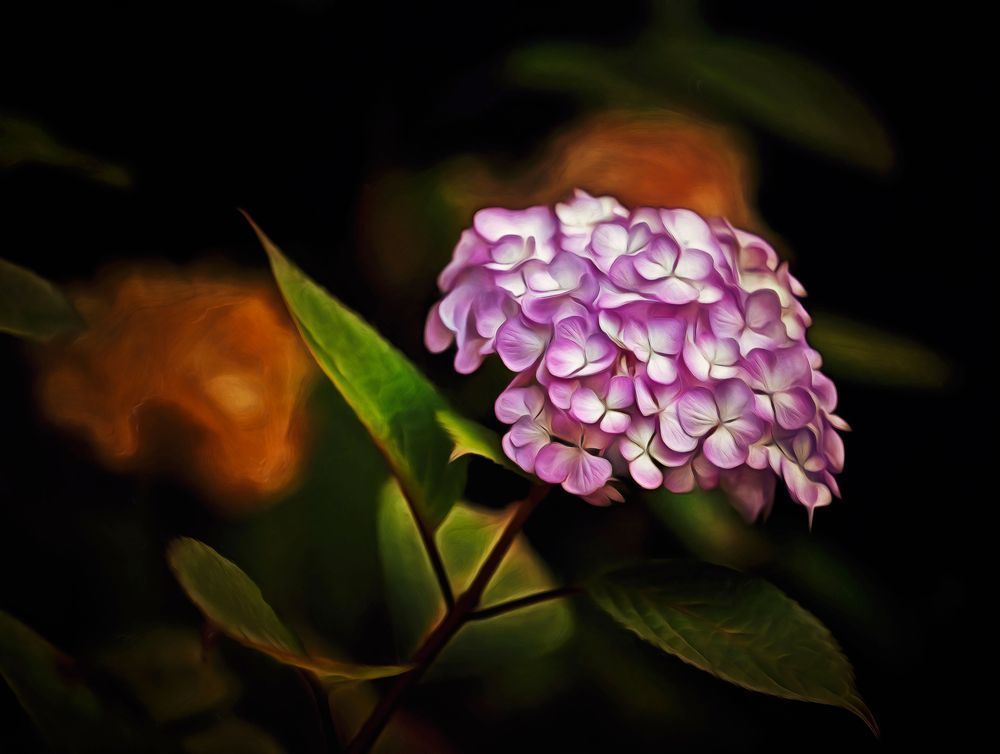
Four Immeasurables as Visual Feelings
"Bella Ortensia in Un Raggio di Sole" radiates as a visual transmission of Empathetic Joy and Loving-Kindness, the two primary boundless principles that emerge most powerfully from this contemplative composition. The hydrangea—rendered in luminous gradations of pink and purple—embodies heartfelt emotion, gratitude, and genuine affection according to centuries of cross-cultural symbolism from Japanese legends to Victorian floriography. These tender color harmonies activate healing properties associated with compassion, unconditional love, and the restoration of emotional balance, creating what contemporary color psychology research identifies as profound calming effects on the nervous system while promoting self-love and alleviating grief. The painting's chiaroscuro technique—inspired by Renaissance masters who pioneered the interplay of light and shadow to create three-dimensional depth and spiritual illumination—transforms the flower into a focal point where divine radiance meets earthly beauty, demonstrating how contrasting tonal values generate emotional resonance and psychological complexity. Through this beginner's mind approach, known in Zen practice as shoshin, physician-artist Dr. Mehta offers viewers an aesthetic experience stripped of preconception, inviting openness, eagerness, and present-moment awareness. The painting functions as an art therapy vehicle by engaging multiple sensory pathways—the eye perceives color vibrancy, the mind processes symbolic meaning, and the heart responds to emotional authenticity—creating what research confirms as measurable reductions in stress hormones, increased dopamine release, and activation of neural pleasure centers associated with mental well-being. This work exemplifies how contemplative art serves as both personal meditation practice for the creator and healing transmission for viewers, establishing what gallery curators recognize as emotional impact worthy of museum-quality designation.
Large Canvas Experience
Displayed at 53×40 inches, this painting commands visual territory that research demonstrates fundamentally alters viewers' perceptions and spatial engagement. At this monumental scale, the hydrangea's delicate petals become an immersive environment rather than mere representation, surrounding viewers in what contemporary gallery professionals describe as a multisensory engagement in which color perception intensifies, emotional responses deepen, and the boundary between observer and artwork dissolves into contemplative absorption. The luminous pinks and purples at this magnitude evoke what viewers report as kinesthetic associations—the soft texture of velvet against skin, the gentle warmth of morning light, the rhythmic breathing of meditation practice—creating what researchers term embodied cognition, where visual stimuli trigger somatic memories and emotional fingerprints throughout the body. Extended contemplation of this large-format presentation activates neural pathways associated with awe, wonder, and psychological restoration, producing measurable increases in alpha brain waves linked to relaxation, reductions in blood pressure and cortisol levels, and what subjects describe as mental clarity, expanded perspective, and feelings of interconnection. The chiaroscuro modeling becomes theatrically dramatic at this scale, transforming the composition into what Baroque masters understood as spotlight illumination—the flower emerging from darkness into radiant presence, commanding attention while inviting viewers into meditative states where time suspends and ordinary consciousness shifts toward what Zen practitioners call flow or absorption. This physical presence in residential or gallery contexts establishes the work as an anchor point that defines spatial atmosphere, with color psychology experts confirming that large-scale pink and purple artworks generate environments perceived as nurturing, spiritually uplifting, and conducive to emotional processing and creative insight. Collectors investing in contemporary art increasingly prioritize pieces that offer this immersive quality and emotional authenticity over conventional trophy acquisitions, recognizing that museum-quality works of substantial dimensions provide both aesthetic pleasure and therapeutic value as alternative assets with cultural significance.