Four Immeasurables as Visual Feelings
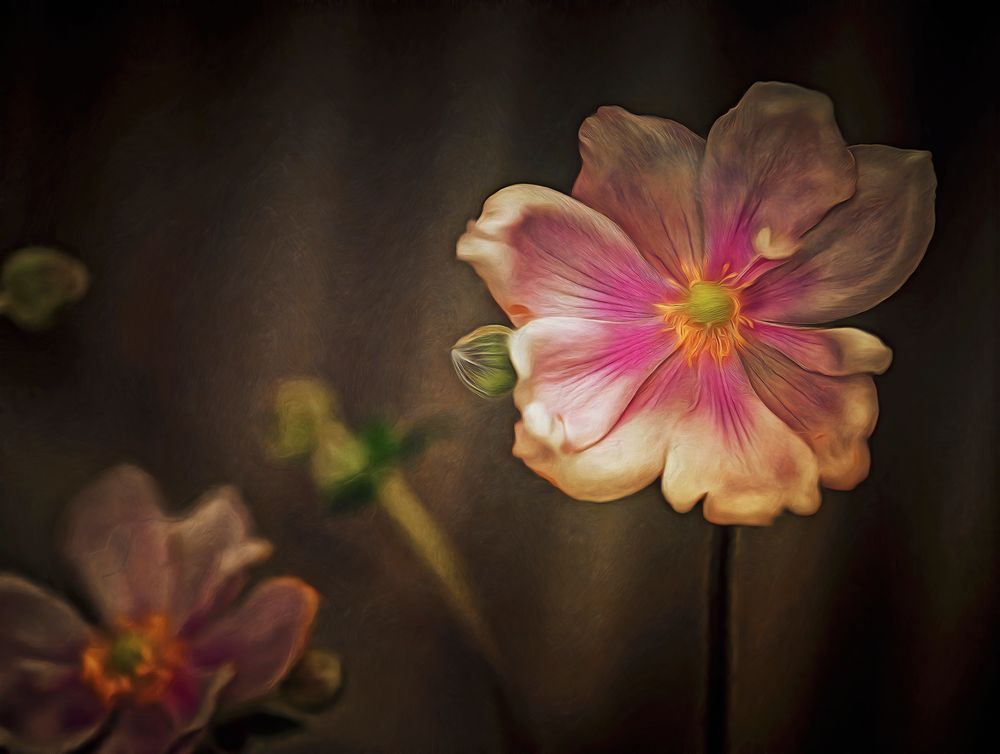
This luminous painting, "Bacio alla Francese," positions itself primarily within the realm of Empathetic Joy and Loving-Kindness, the two boundless principles that radiate through every chromatic decision and compositional element. The delicate pink and cream anemone blossoms emerge from atmospheric darkness with such tender vulnerability that they embody what contemplative traditions call mudita—the rare capacity to rejoice in beauty without possessing it. The warm palette of rose, amber, and golden yellow creates what research identifies as an emotional contagion effect, where the painting's inherent joy transmits directly to viewers through neurological pathways activated by these specific color frequencies. The chiaroscuro technique—that Renaissance-inspired interplay of radiant light and velvety shadow—functions as a vehicle for the physician-artist's decades of medical practice guided by compassion and equanimity. Every petal bathed in luminous warmth becomes an offering of unconditional friendliness, inviting viewers into what art therapy research describes as a non-stigmatizing healing environment where authentic connection flourishes. The painting operates as what Buddhist visual traditions call a support for practice, where the act of sustained viewing becomes inseparable from the cultivation of boundless states within the observer's own awareness.
Large Canvas Experience
When encountered at its intended monumental scale of 53×40 inches, this work transcends mere observation to become, as contemporary gallery research identifies, an experiential phenomenon that commands immediate physical presence. The substantial format creates an immersive environment where viewers find themselves enveloped by the radiant warmth of the chromatic fields, triggering what neuroscience confirms as dopamine release associated with pleasure and reward. At this impactful scale, the warm palette—those rose-gold transitions and amber highlights—intensifies through what researchers describe as emotional landscape perception, where color saturation and tonal modeling engage the viewer's autonomic nervous system directly. Extended contemplation reveals multisensory associations: the soft petals evoke tactile gentleness, the golden center hums with a frequency akin to sustained tones, and the flowing composition suggests the rhythmic movement of breath itself. The substantial dimensions create what gallery studies identify as a psychological anchor effect, where the work's commanding presence establishes an immersive field that contemporary collectors increasingly seek for mind-body resonance rather than simple aesthetic decoration. Research on large-format artwork confirms that this monumental scale allows viewers to experience what Mark Rothko understood: that expansive fields of carefully orchestrated color relationships can provoke responses ranging from meditative stillness to transcendent uplift, functioning as visual sanctuaries that nurture emotional resilience in healthcare and residential environments alike.